

Is AI Search Overhyped for Built Environment Firms?


Has anyone else's inbox turned into a GEO newsletter? Over the past few months, I reckon every marketing agency in our corner of the industry has written about generative engine optimisation, usually with a warning that your firm is about to vanish from the internet.
Mike and I have spent a fair bit of time poking at this, partly for clients and partly because we wanted to know whether it applies to us. So, here's the honest answer up front. AI search does matter for built environment firms, though less than the noise suggests, and the work it asks of you is mostly work you should be doing anyway.
Let me walk you through the thinking behind that.
What the numbers say
The headline figures you'll see quoted are real but look at who was surveyed. G2's April 2026 survey found 51% of B2B software buyers now start their research in an AI chatbot rather than Google. Responsive's buyer research found people buying technology lean on AI to find suppliers far more than buyers in other industries. Useful to know, although a software buyer behaves very differently from a developer appointing an engineer.
Closer to home, the picture is more mixed. A Magenta Associates survey of 300 UK senior decisionmakers found around two-thirds now use tools like ChatGPT, Copilot or Perplexity to find and assess suppliers. RIBA's latest survey says 74% of architecture practices use AI on most projects, up from 59% a year earlier. So the people we work with, and the people who hire them, are comfortable with these tools. I'd just point out that RIBA is measuring design and admin work, not how clients pick their architect.
Then there's traffic. Ahrefs tracked AI chatbots sending 0.28% of all web traffic in March 2026, against just over 28% from Google. When we looked at one engineering client's analytics, AI didn't even register as a source worth mentioning.
Here's where I'd be careful, though. Low traffic doesn't mean low influence. In one small study of 48 people making big purchases, 64% of those using Google's AI Mode clicked nothing at all; they read the answer and moved on. If a client asks AI about your firm and gets a thin or wrong answer, you won't see that visit in your analytics. You'll just never hear from them.
Where can it cost you work
From what we've seen, AI tends to matter at three moments.
The check after a referral. Someone recommends you to a developer. Before they pick up the phone, they ask ChatGPT what your firm is known for. If the answer is vague, out of date or mixes you up with someone else, you've lost ground before the first conversation.
New clients outside your network. A developer moving into a new region, or a main contractor looking for a consultant to team with on a public job, has no one obvious to ask. So, they ask AI for a shortlist, and the firms that come back get the first call.
The bid team's homework. I suspect plenty of procurement and bid managers now use AI to get a quick read on who's who before a framework or tender. Whatever it says about you feeds the long list.
I’ll own up to one of ours. Over the years we’ve appeared online as both The Dux and The Dux Digital, used more than one name for our method, and left a couple of old directory listings describing us as a general digital agency. There’s also an Australian agency called Dux Digital. For a firm that helps others with their positioning, that’s a bit awkward to admit.
Where it barely matters
To keep this in proportion, think about where your work comes from. For the firms we work with, turning over somewhere between £1m and £15m, the bulk of revenue tends to come from repeat clients, framework call-offs and people who already know them. A client who has used you on three schemes isn't asking ChatGPT whether you're any good. A framework manager allocating work looks at how you've performed on the framework.
Responsive's research makes a similar point from the buyer's side: once a supplier reaches the table, formal evaluation materials still carry the weight. Proposals, case studies, references and the people in the room still win the job.
So, if someone tells you AI search is the biggest threat to your pipeline, I'd ask what's happening to your referrals and repeat business first. Those numbers will tell you far more.
Here's how I'd sum it up:
What it asks of you
Here's the bit the GEO sales pitches tend to skip. For a professional firm, being findable by AI rests on the same things that help you win work with people. AI tools build their answers from what they can find and trust you, on your own site and elsewhere.
- One name used everywhere. If your website, LinkedIn page, Companies House record and directory listings use different versions of your name, AI struggles to work out you're one firm.
- Pages that say exactly what you do. A page per sector and per service, naming the project types, sizes and places you work. "Multi-disciplinary engineering solutions" tells a machine nothing, whereas "structural and civil engineering for residential schemes across the Northwest" tells it plenty.
- Case studies with names and numbers. Client, project value, programme, outcome. A case study without specifics is hard for a client to trust and harder for AI to quote.
- Other people talking about you. Mentions in trade press, awards lists, framework announcements and industry directories, even without a link, help AI tools trust that you are who you say you are.
- Detailed reviews. A Google review that names the project type and location does far more work than "great team, highly recommend".
None of this is new. Every item on that list would make your firm easier to choose if AI didn't exist. So, I'd treat AI visibility as one strand of your positioning rather than a separate project.
A 15-minute check you can run this week
You don't need a tool or an agency to see where you stand. Open a private browser window, make sure you're logged out, and ask ChatGPT, Gemini, Perplexity and Google's AI Mode these three questions:
- Who are the best [your discipline] in [your city or region]?
- Which [your discipline] in [your region] have experience in [your main sector]?
- What is [your firm name] known for, and would you recommend them for [your typical project]?
Then note three things for each answer: whether you're named, whether what it says about you is right, and which firms come up instead. Four tools and three questions give you twelve answers, enough to spot a pattern.
If you come out of it well, brilliant. If you don't, the list in the previous section tells you where to start, and it'll help you win work whatever AI does next.
How to tell if it deserves more of your time
Rather than take my word for it, or anyone else's, let your own numbers decide. Mike, who looks after the analytics side of things for our clients, suggests two quick changes:
- Give AI its own line in Google Analytics. Set up a custom channel group in GA4 that pulls visits from chatgpt.com, perplexity.ai, gemini.google.com and similar into one place, rather than letting them disappear into referral or direct traffic.
- Add one option to your enquiry form. If you ask, "How did you hear about us?", add "ChatGPT or another AI tool" to the list.
Give it three months. If AI starts turning up in your enquiries, put more effort in. If it doesn't, you've lost nothing, and you can spend the time on the things already bringing in work.
So, is it worth the fuss?
My view? Yes, a bit, though not in the way it's usually being sold.
AI search is changing how some clients check and shortlist consultants, and it's worth knowing what it says about you. I just wouldn't let it pull attention away from what wins work in our industry: sharp positioning, proof with numbers, and relationships you look after. Get those right and you'll show up better in AI answers almost as a side effect.
If you run the 15-minute check and want a second pair of eyes on what came back, or on how your firm is positioned more generally, Mike and I are always happy to talk it through.
Or, if you'd rather keep an eye on this from a distance, Dux in Formation lands in your inbox every month with what we're seeing across the sector. Subscribe to Dux in Formation
Sources used
- Ahrefs, AI chatbot traffic (includes the 48-person AI Mode study)



Jason Windle talks to Tony McPartland. Tony went from knocking on doors in North East London to managing director by his early 30s.
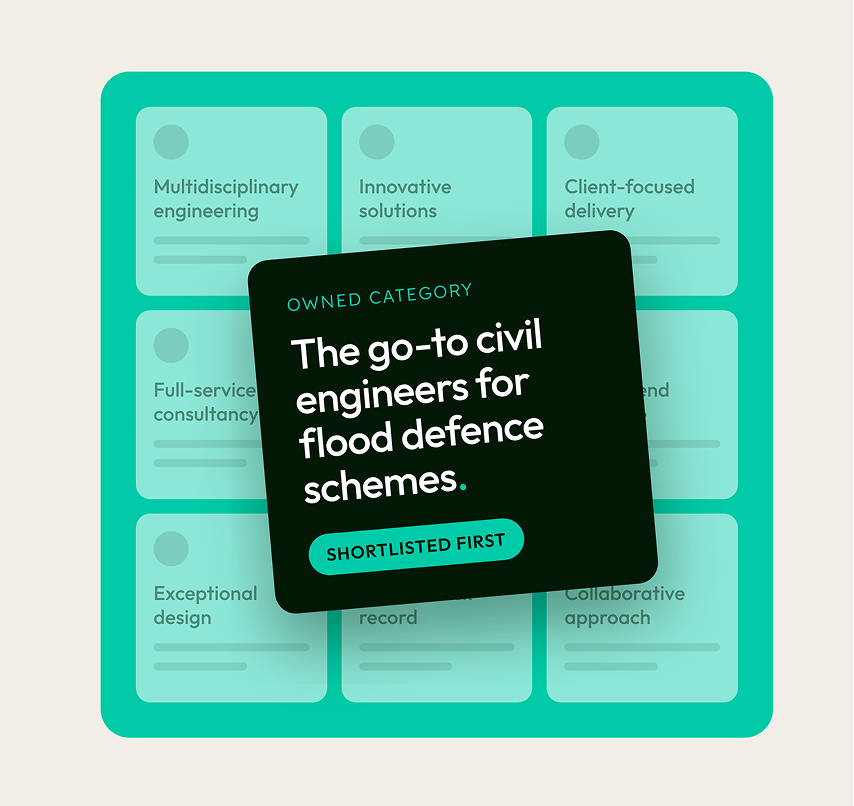
Picture the tender list for a mid-sized infrastructure scheme: eight consultancies, each with a capability statement promising innovative, client-focused solutions, and a client who reads them over a long weekend and can't remember by Monday which firm said what.
Stop guessing. Start growing.
Book your Growth Assessment and let’s build your growth engine.


