

How to Own a Category Instead of Competing in One

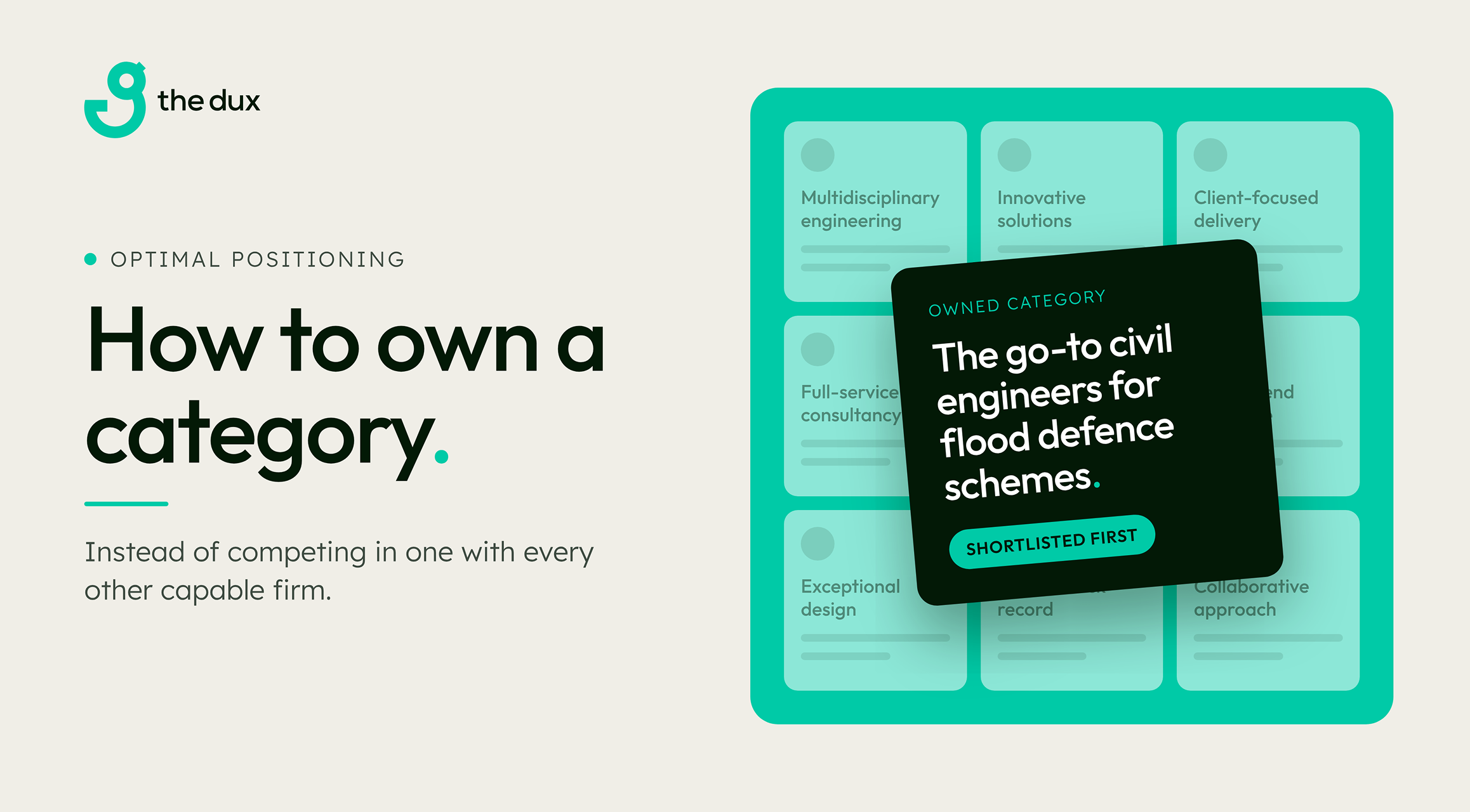
The shortlist no one remembers
Picture the tender list for a mid-sized infrastructure scheme: eight consultancies, each with a capability statement promising innovative, client-focused solutions, and a client who reads them over a long weekend and can't remember by Monday which firm said what. The decision then comes down to the one thing they can compare easily, which is the fee.
Competing in a category means fighting for a place on that list alongside everyone else who does broadly what you do. Owning a category means being the firm a client thinks of first for a particular problem, often before the list exists at all.
Category ownership sounds like something reserved for tech start-ups with venture capital and a launch party. For an engineering consultancy or an architecture practice, it's far more practical: choosing the ground you can credibly own, then making sure the right buyers know it's yours.
Here's how to do it, with a worked example from one of our own clients.
Competing in a category versus owning one
When you compete in a category, you're one of many credible options, and buyers compare you to whatever is easiest to compare: fee, availability and a handful of similar projects. When you own a category, buyers arrive with a problem and a shortlist of one or two names, and yours is on it.
A category doesn't have to be grand. "Structural engineering" is a crowded market, whereas "structural engineering for heritage conversions in the North West" could be a category one firm
owns, as could civil engineering for data centre campuses or architecture for multi-academy trusts. The sharper the definition, the easier it is for the right buyers to remember you, and the easier it becomes to turn down work that pulls you off course.
Owning a category doesn't mean abandoning everything else, and you can still take work outside it. The category simply decides what you lead with, what you invest in and what you become known for.
A worked example: when perception lags capability
One of our clients, a nationwide UK civil engineering consultancy with decades of experience on complex projects, had a problem plenty of established firms will recognise. Its delivery capability was strong, and its leadership wanted to grow into a more corporate, multi-disciplinary consultancy. The market, however, still saw a traditional consultancy.
The gap between what the business could do and what buyers believed it could do was holding it back in three ways:
- Limited room to grow. Its existing positioning made it hard to move credibly into adjacent sectors such as ecology and environmental services.
- A credibility gap early on. Its brand and digital presence didn't reflect the professionalism larger organisations look for at the start of the buying cycle.
- Price pressure. Without a distinct position, opportunities tended to become price-led instead of value-led.
We started with commercial positioning, working with senior stakeholders to define how the business should be seen as it expanded, in a way that created room to grow without undermining the credibility it had already earned. From there, we rebuilt the website and digital presence so decisionmakers could quickly recognise the firm's scale, professionalism and strategic capability. Finally, we made sure the external story matched leadership's ambitions, its plans for new services and the people it wanted to recruit.
The firm is now positioned as a future-focused consultancy. It has credible headroom to diversify into adjacent built environment sectors, larger organisations see it more favourably before tenders are issued, and it relies less on late-stage persuasion and price competition. Its employer brand has improved too, which matters for a firm that needs to grow its capability.
Every step built on capability the firm already had. The work was about closing the gap between what it could do and what the market believed, then claiming a category it had already earned. [Read the full case study]
Five steps to own a category
- Find the ground you've already earned
Start with evidence instead of ambition. Look at your last five years of projects and ask where you've done your best work, made your best margins and built the strongest client relationships. Your category usually sits where those three overlap. If you'd like a structured way to do this, our [Specialist Focus Scorecard] rates each sector on margin, track record and demand.
- Define the category in your clients' words
A category only works if buyers recognise it. Describe it the way a client would describe their problem, not the way your team describes its services. "Getting heritage buildings through planning and into use" will land with a developer far better than "conservation-led structural design".
- Close the perception gap
Compare what you can deliver with what the market believes you deliver. Read your homepage and capability material aloud, look at your last three proposals and ask a few trusted clients how they'd describe you to a peer. Wherever the answers fall short of reality, that's the work to do first. Our [Positioning Self-Audit] takes you through the questions.
- Prove it with specifics
Ownership comes from evidence, and the more specific, the better. Publish case studies that show the challenge, your thinking and a measurable result. Put named experts forward and share a point of view on the issues your category cares about. One sharp article on a problem your buyers face every week will do more than a dozen award announcements.
- Show up before the brief is written
A category you own is a category you're visible in. Make sure the right people see your thinking regularly, long before they need you: on LinkedIn, in a newsletter, at the events your buyers attend and in conversations with past clients. When the project finally becomes real, you want to be the name they already associate with it.
How to tell it's working
Category ownership builds gradually, so look for these early signals:
- Enquiries mention your specialism by name.
- You're invited in earlier, and the shortlists get shorter.
- Fee conversations ease, because buyers are comparing you on fit.
- Referrers can explain in one line why someone should call you.
- Saying no to poor-fit work starts to feel easier.
Four traps to avoid
- Choosing a category no one buys. Passion for a sector isn't enough on its own. Check there's real, growing demand before you commit.
- Defining it so broadly it means nothing. "Sustainable design" is a value most firms claim. A category should feel almost uncomfortably specific.
- Changing direction every quarter. Buyers need time to connect your name with the category, so give it at least a year before judging it.
- Forgetting the clients you already have. Tell them first. They're the people most likely to repeat your new story to others.
Ready to own your category?
Choosing a category is one of the most important commercial decisions a firm makes, and it's hard to do from the inside. You're close to your own work, proud of all of it and wary of narrowing your options.
In a Strategy Session, we'll look at where your firm has already earned the right to lead, how the market sees you today and what it would take to close the gap. You'll leave with a clearer view of the category worth claiming and the first steps to claim it.



Growing an SME built environment consultancy can feel like a game of luck dictated by the whim of the market.

Explore why perception can lag behind reality, the commercial risks this creates and how firms can build positioning that supports long-term growth.
Stop guessing. Start growing.
Book your Growth Assessment and let’s build your growth engine.


